
 Menu
MenuEngine tuning.
Engine tuning.
Smaller engines generally have little scope for tuning. When you exceed the base output of the engine by a factor of 25-50% more you may start to hit reliability issues. (Turbo engines generally speaking have wider tolerances than a NASP engine.)
It pays to use good quality performance parts and sadly each performance modification will reveal a weakness elsewhere in the car. (Read the hidden cost of car tuning.)
Our overall aim in tuning is to provide a good compromise between the peak power, fuel economy and long term reliability. We look jealously on at motorsport teams and the heady power figures they achieve.
What does torque mean in a car engine? Find out here.
We need to remember that these cars are stripped down and rebuilt after each race, or at least a few times in a racing season.
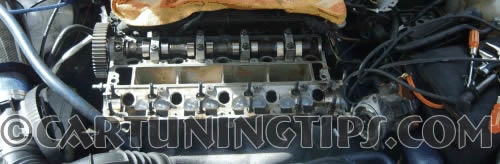
The greater the capacity and horsepower the larger the amount of power gains open to you. Turbo engines represent the best potential for power increase as a remap will change the timing of the engine as well as the wastegate control (forcing more air into the engine) and fuelling.
Often a remap of a standard turbo engine can provide reliable power gains of up to 50% base power, equating to around 50-75 extra bhp. On a naturally aspirated engine you will get a much smaller power gain for the same money. Expect to pay around $500, £300 for a remap. To get a 20bhp or more power increase on a NASP engine you are looking at more than a simple remap and will need to spend 2-3 times this amount on other engine modifications.
-
Turbos,
Remap the turbo, fit a larger or aftermarket turbo, uprate the exhaust and fit an induction kit. Cams, head work and bottom end strengthening are required for power hikes of 50-100% depending on the source engine. (Turbo tuning see also the mods for NASP engines for the next stage as these will give even larger returns on turbo engines.) -
NASP (Naturally aspirated engines)
Ignore all smaller engines (sub 1600cc engines unless they have a high red line around 7500 rpm). For all engines over 1600cc you should fit (in this order) fast road cams, full sports exhaust, induction kit and get the head gas flowed. Finally when all other modifications have been done address the engine timing with a remap. A big valve conversion and head work like porting will further increase the power output. (If you want to add forced induction your best bet will be a supercharger kit.) -
Rotary engines.
These are very high revving and are fairly tolerant of power increases. Look to improve the flow of air through the engine with a full sports exhaust and induction kit . Uprating the fuel pressure and injectors will allow bigger gains to be made. Balancing and Gas flowing the engine will also improve things a little but most rotary engines are well machined to start with. Fitting forced induction or increasing the capacity of your rotary engines blower will also yield larger power gains.
General notes:
Traction can be a big problem on FWD (front wheel drive) cars. With front wheel drive cars exceeding 250bhp we would recommend substantially softer and more grippy tyres and a slightly softer suspension than you would otherwise use in competitions. It gets really hard to control this sort of power on a FWD even with a good strong LSD and will show up flaws in your chassis. Clutches are also potential weakspots in tuned engines so you may need to look at uprating your clutch.
In rear wheel drive there are no such restrictions on power output although a carbon fibre driveshaft will also help to put the power down more smoothly and take some of the stress from your drivetrain. Also if your tyres are unable to grip the road the power will be lost so again you will need to think about performance tyre upgrades.
Gearing. When increasing or changing the Torque curve of an engine it is best to alter the gear ratio's to allow you to better exploit the power. Lower ratios will nearly always give better acceleration but you want to keep the engines powerbands spread through the gears.