
 Menu
MenuCar tuning tips:Gas flowing a head"
Gas flowing a head Many things go on in the head of an engine. Primarily the air coming into the engine flows through the head and into the cylinder via an open inlet valve.
The air moving into an engine is travelling at high speed and any turbulence caused can substantially alter the flow of the air.
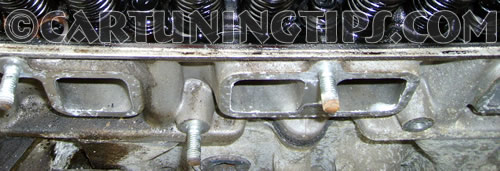 Think of air like water. If you dive into a pool of water and land flat, the soft gentle water becomes hard and you really feel it. The difference is the speed you are travelling at.
The faster you smash into the surface the harder it seems. Also moving quickly in water takes proportionally more effort the faster you go due to the increased drag. Air travelling at speed also becomes 'solid'.
I know that the physicists out there will pick me up on this but it is really the simplest analogy I can use to describe the way air moves and flows.
A small ridge or dimple in the surface that the air is flowing over will create a turbulent stream and effectively slow up the flow of air. When you gas flow a head the aim is to get the air moving as freely through the head as possible.
Bends are either eliminated or made more shallow. Where possible the physical area inside the head is increased to allow for greater flow of air. Larger valves will also enable the air to flow into the engine more freely.
The larger the engine capacity the bigger the benefit of gas flowing the head as more air is moving around. Gas flow is measured on a flow bench and as the head is worked it is remeasured. A professional will get a feel for the type of channels that need to be made inside the head.
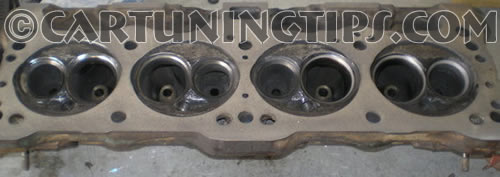
Inside the head near the valves there are often steps where a mass produced head is knocked out of the factory for speed. Removing these steps will further enhance the air flow and many car owners report a noticeable power increase solely from this machining away of the steps and grooves around the valve. Particular attention should be paid to the ports.
These are the holes into which the induction manifold connects to the engine and the exhaust headers connect to holes on the other side of the head. Aim to get the holes matched up avoiding steps or ridges for smooth inlet and exhaust from the engine.
Although porting can be carried out with a drill with a grinding wheel (performed with long sweeping strokes to avoid cutting new grooves and steps into the ports) it is advisable to get this properly machined for best results.
Air flow needs to be carefully balanced through each port, and even slight uneven undulations can affect this balance significantly.
Areas to be checked are the valve seams. If these do not properly close there will be a loss of air flow and potentially substantial decrease of power. Valves should always be properly seated and a grinding paste can help improve the closure of the valve to the head.
Check out TorqueCars new YouTube channel, and see their awesome new content...
Feedback
Please use our forums if you wish to ask a tuning question, and please note we do not sell parts or services, we are just an online magazine.
Help us improve, leave a suggestion or tip
8 Responses to “Gas flowing a head”
Hi thanx for the tips i apreciate it you are realy helping
[…] also the article on Gas Flowing a head as this is very closely related to port matching and the terms are often used interchangeably. Gas […]
Hi. i currently own a 2007 citi golf. it is a 1400 carburetor engine. i would like to know what i can do to make my car faster without the changing the engine. i am currently thinking about working the bottom end to a 1800. would i then have to change the head as well? what else can i do? please advise as my car really has no power
Nice info.do u hav sketches.much appreciated.
HI I RUN A 2LITRE ENGINE IN A VW CADDY AND I USE THE ORIGINAL 16 00 GEARBOX. IF I PUT A DIFFERENT GEARBOX, WILL I GET MORE POWER. ANY RECOMMENDATIONS ON GEARBOXES
I need something on how to port and flow an 8v vw head. please advise
Yes lebo if u change ur gearbox it will gain u more power and since u got a 2.0l motor and a 1600 box the ratio is different so da gears are delayed hampering da vehicle of its true speed ..
Changing the gearbox won’t give you more power. Your engine makes a certain amount of torque, and the gearbox does not have anything to do with the engine’s power output. The ratios of a gearbox just determine the top speed and the in-gear acceleration of the car. Obviously very long gears won’t allow the engine to climb into it’s optimal power peak, thus shorter gear ratios will probably give better acceleration. The size of your engine doesn’t dictate the gear ratios of your gearbox. You can put a 2.0 motor onto a “1400” gearbox and there won’t be a difference in the gear ratios. Just keep your current gearbox and spend money on getting a cam for your 2.0. A 276 Estas cam will work nicely with your 2.0 motor