
 Menu
MenuAll you need to know about "Performance sport exhausts"
Engines need to get rid of the exhaust fumes created by the combustion process in the same way that we need to breathe out when our bodies have consumed the oxygen in our lungs.
If our nostrils were blocked up we would and we had a narrow straw to breathe through we would be comfortable, unless we started to exert ourselves. We would quickly need to ease off because we couldn't breathe.
All engines work on the same principle, if the exhaust is too narrow the engine will struggle to breathe properly and performance will be impaired.
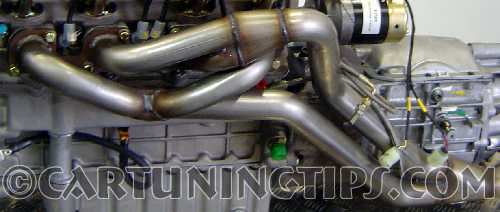
 Headers, these connect the engine to the exhaust pipe. A typical engine has 4 ports (6 if it is a 6 cylinder etc) and these are channeled down into a single tail pipe. If there are rough parts in this header or the shape inhibits the flow of the engine then it will take longer to expel the exhaust gasses and also be much harder to do so fully.
Most standard headers are cast in iron and this leaves a pitted surface and often thick cast seams are left in the metal. These cause turbulence and are not good for performance.
Stainless steel headers make for a better flow, the bends can be more precisely made and the internals are seam free.
A standard cast header can be improved with a grinding wheel and polishing wheel. Smooth out the rough internals and remove any cast seams. Aim also to reduce the internal angles by grinding away the excess metal. Do not weaken the metal by making it too thin.
Down pipe flexi coupling.
This prevents vibration from the engine affecting the exhaust mountings and also protects the engine from car body movement. Again this should be internally as smooth as possible and any welded seams should be smoothed down.
Catalysts.
A subject in their own right. This forces the exhaust gases to react with the catalytic material to reduce the emissions of the engine. A free flowing sports cat can do a little to increase the power output of the engine. Removing the cat altogether can cause problems in a closed loop system and will not yield much of a noticeable power gain over a sports catalyst.
Overall gains for a sport cat or de-cat installation are 2-6 bhp.
The main exhaust pipe.
This will need to bend around the contours underneath the car but it would be best to minimize the bends as much as possible. Generally though the exhaust has to go around the rear axle so bends cannot be avoided.
When joining pipes of different diameters you should always make the join a cone shape otherwise you will suffer from a turbulent flow of exhaust gases. Stainless steel is a good long life material provided it is bent to shape rather than cut and welded.
Rear silencer.
Sometimes cars have an expansion box before the final silencer. The job of the silencer is to control and muffle the noise of the engine. In most setups the exhaust gasses are channeled through a series of baffles which contain a sound deadening material. The more freely the exhaust gases can flow through this the better.
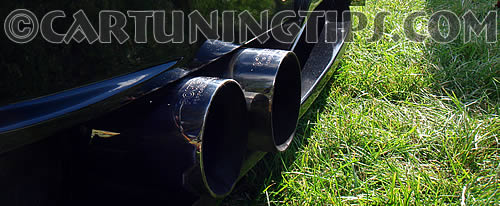
The larger the bore of the silencer the deeper the tone of the exhaust. Twin pipes and slashes do little to alter the flow of gasses and are primarily there for aesthetic purposes but the larger the volume of these pipes the greater the air flow.
So the bigger the exhaust the more power you can make, right? WRONG!
A large exhaust will flow more slowly than a narrow one so the size to flow rate is critical. The fast exiting exhaust gases help with cylinder scavenging and this effect is lost if the flow rate is slowed right up.
For interest you should note that a large exhaust will reduce the low down torque of the engine and leave it with little pulling power until the RPM increases.
The diameter of the exhaust is a precise calculation and takes into account the engines volumetric efficiency. The exhaust is too large if local cats can sleep inside it at night! Ideally you want less back pressure as the engine revs increases. To achieve this some manufacturers have fitted a valve to the exhaust which opens to increase the flow rate of an engine at high rpm allowing for the best of both worlds.
Check out TorqueCars new YouTube channel, and see their awesome new content...
Feedback
Please use our forums if you wish to ask a tuning question, and please note we do not sell parts or services, we are just an online magazine.
Help us improve, leave a suggestion or tip
One Response to “Performance sport exhausts”
ceramic coating done by thermal spray process will be effective?