
 Menu
MenuExplore Remote turbo kits"
It can be quite time consuming to add a turbo charger to a NASP engine.
The biggest problems include avoiding detonation, making space to join the turbo to the exhaust and sorting out the fueling and mapping.
Although still a big job the remote turbo is being hailed as the simple bolt on solution for NASP engines.
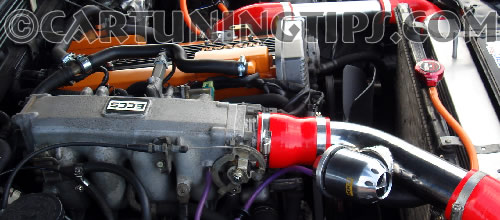
A remote turbo, so called because of it's remote location is generally fitted at the back of the car near or instead of the rear silencer. It can also be mounted part way along the exhaust but this can be prone to damage and reduces the cars ground clearance.
The remote location ensures that the exhaust gases are substantially cooler than they would be in the exhaust headers.
Due to the catalyst and expansion box the exhaust gases are also flowing a little slower. These two factors make it a lot easier to add a remote turbo.
The lower boost they produce and cooler temperatures they run at help the simplify the installation. The long pipe run back to the air intake will act as an intercooler, negating the need for an additional intercooler.
Your remote turbo will need a very good supply of oil and we would recommend fitting an oil pump and taking an oil feed from the engine sump. An inline oil cooler can help if temperature issues ensue.
Although remote turbo kits are available you can actually source suitable turbos from breakers yards and salvage agents. Go with a small turbo set to low boost with a wastegate and diverter valve for best results, unless you are prepared to lower the compression of the engine.
You will need to adjust the fueling and the engine mapping to cope with the additional supply of air and this is best done on a rolling road.
Avoid detonation by running a low boost, using high octane fuel and adding a water injection system if you do not want the expense and inconvenience of a full engine rebuild.
Check out TorqueCars new YouTube channel, and see their awesome new content...
Feedback
Please use our forums if you wish to ask a tuning question, and please note we do not sell parts or services, we are just an online magazine.
Help us improve, leave a suggestion or tip
One Response to “Remote turbo kits”
Do it right!!!!!!! STS Turbo makes a DIY universal kit for people that want to remote turbo there vehicles. Using this kit like I did will ensure that you are getting the correct size turbo for remote mount, the turbo will be BRAND NEW with WARRANTY, plus you get the complete oil system for both feed and return. And most important you are not VIOLATING there patent. I could not believe how much stuff I got with my kit, and how easy it was. Since they have already done the R&D work you won’t have to. The best part is full boost by 3000 RPM on a 3.0 V6.